
Resources for learning your way into improvement.
From practical tools to field-tested insights, our resources help leaders and teams strengthen their improvement practice over time. Use them to build shared language, deepen capability, and support work that lasts beyond a single initiative.



Publications
-
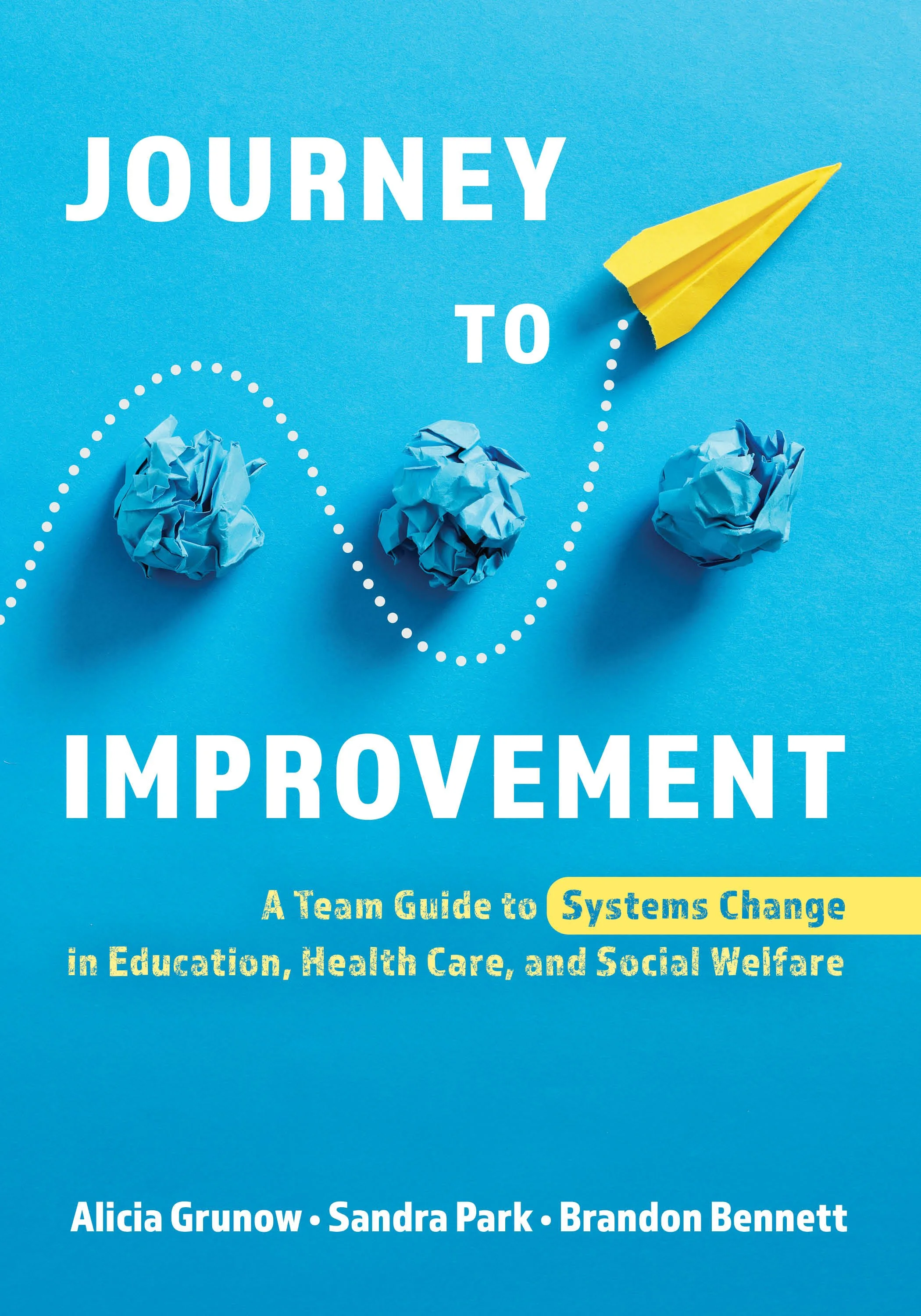
Journey to Improvement
A Team Guide to Systems Change in Education, Health Care, and Social Welfare
-
Improvement Science at Your Fingertips
A Compilation of Resources for Coaches of Improvement Science
-

Learning to Improve
How America’s Schools Can Get Better at Getting Better
Resources
This collection of resources has been made possible by the Bill & Melinda Gates Foundation. These resources are intended to help support teams through an improvement journey.



















Peer-Reviewed Articles & Commentaries
-
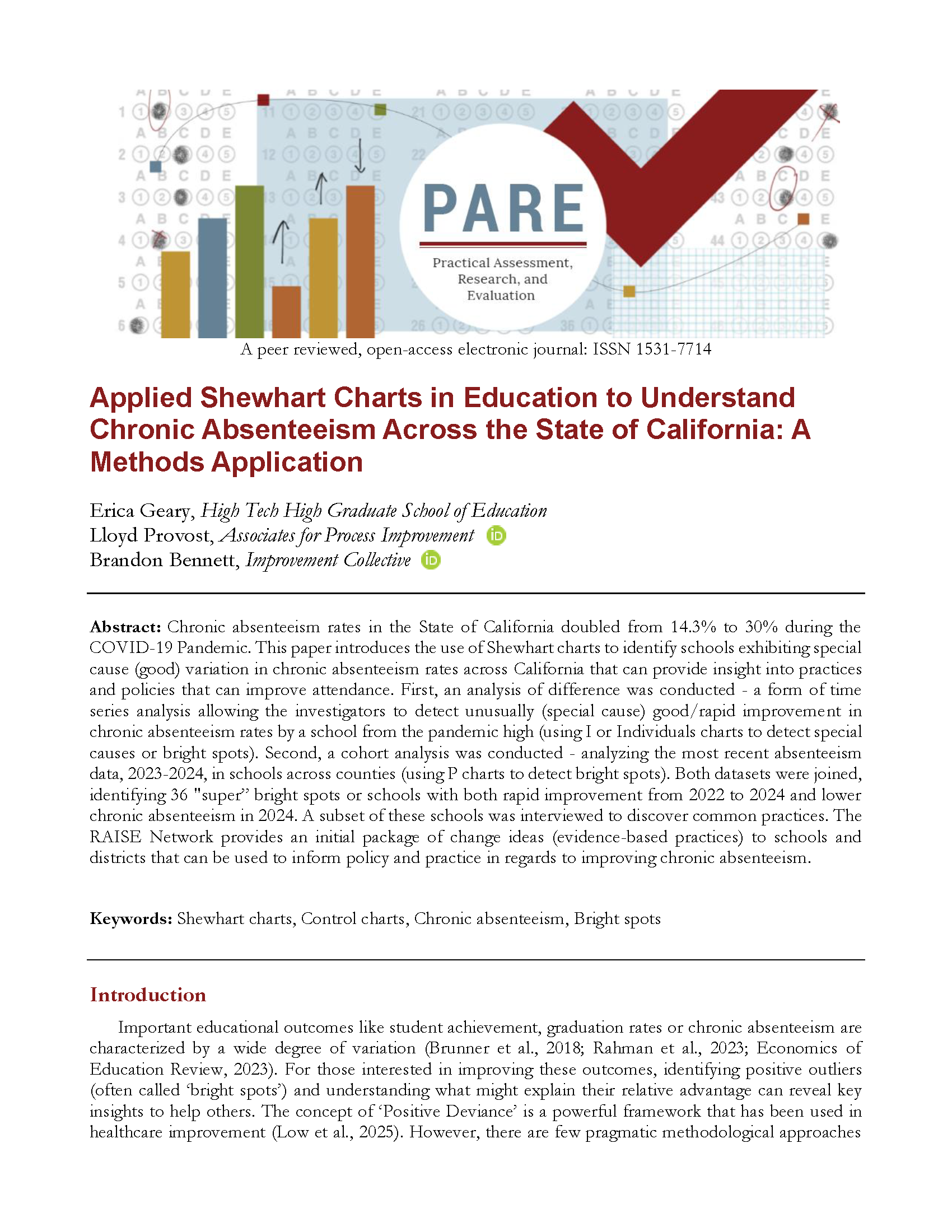
Applied Shewhart Charts in Education to Understand Chronic Absenteeism Across the State of California: A Methods Application
Erica Geary, Lloyd Provost, and Brandon Bennett show how Shewhart charts can help educators and researchers identify unusually strong improvement in chronic absenteeism across California schools and learn from the practices behind those results.
-

Let’s use data correctly to understand the crisis of chronic absenteeism
In this commentary, Ben Sanoff and Brandon Bennett argue that control charts can help educators make better sense of chronic absenteeism data by distinguishing meaningful change from normal variation and shifting attention from blame to learning.
-

Special Delivery
Brandon Bennett describes change packages as practical knowledge artifacts that help organizations codify learning, share proven ideas, and guide improvement in new contexts.
-
Branching Out
Brandon Bennett describes measurement trees as a visual tool for linking change ideas, system performance, and desired outcomes across an improvement journey.
-

What's your Theory?
Brandon Bennett and Lloyd Provost show how driver diagrams help improvement teams connect aims, drivers, and change ideas in a shared theory they can test and refine over time.
-
Increasing early childhood education enrolment and attendance rates in South Auckland, New Zealand
Jilly Tyler, Monique Davies, and Brandon Bennett examine how early childhood centres in South Auckland used improvement methods to raise enrolment and attendance while building staff capability for sustained change.
-
Towards a Common Vision of Continuous Improvement for California
Alicia Grunow, Heather Hough, Sandra Park, Jason Willis, and Kelsey Krausen examine how California’s education system can build a shared understanding of continuous improvement and the conditions needed to support it statewide.
-
Continuous Improvement: Building System Capacity To Learn
Alicia Grunow and Heather J. Hough outline how continuous improvement can strengthen California’s education system, while highlighting the investment, training, and data systems required to make that vision real.
-
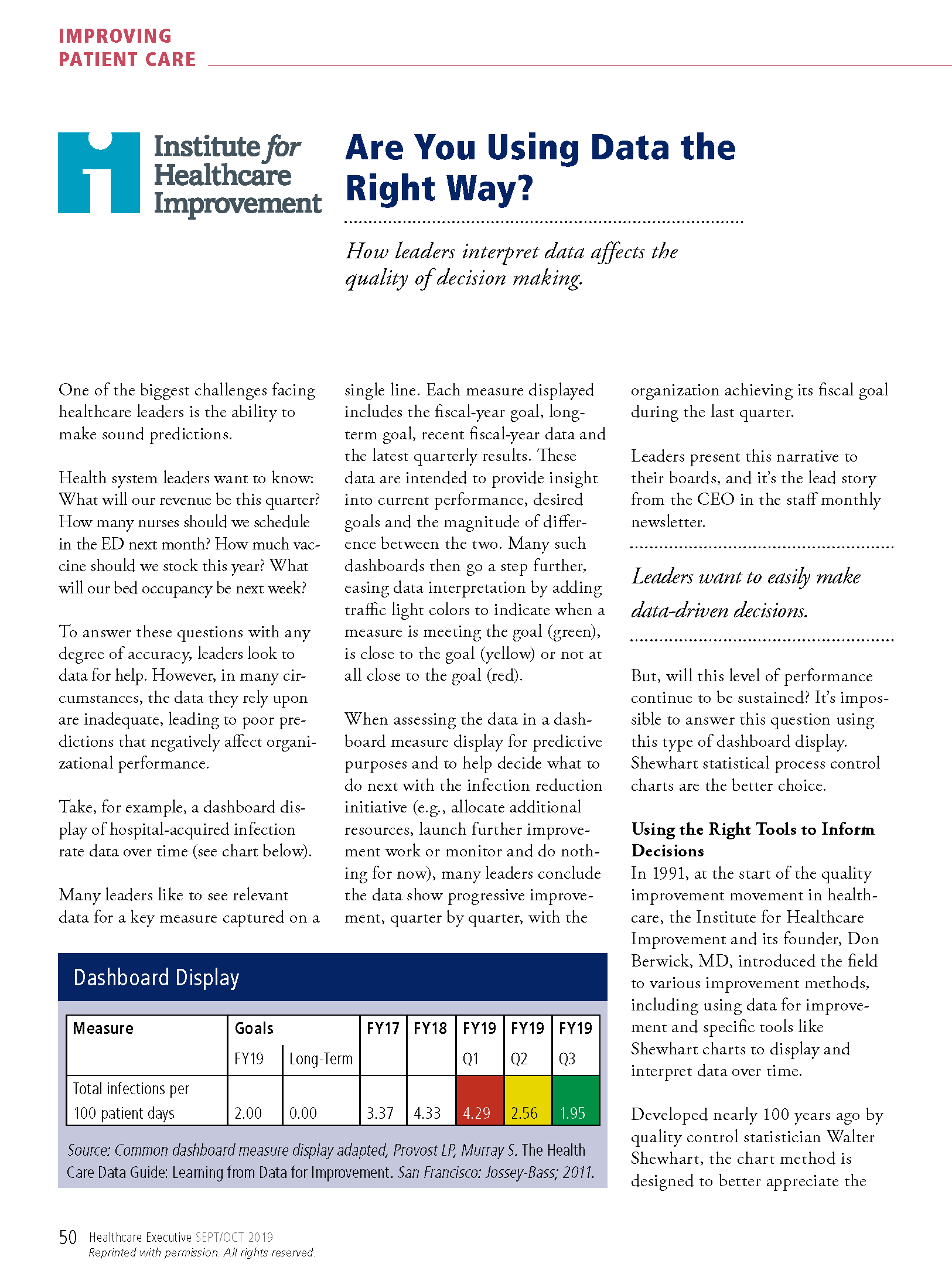
Are You Using Data the Right Way?
David M. Williams and Brandon Bennett explain how healthcare leaders can use Shewhart charts to read performance over time, understand variation, and take more disciplined action to improve system performance.
-
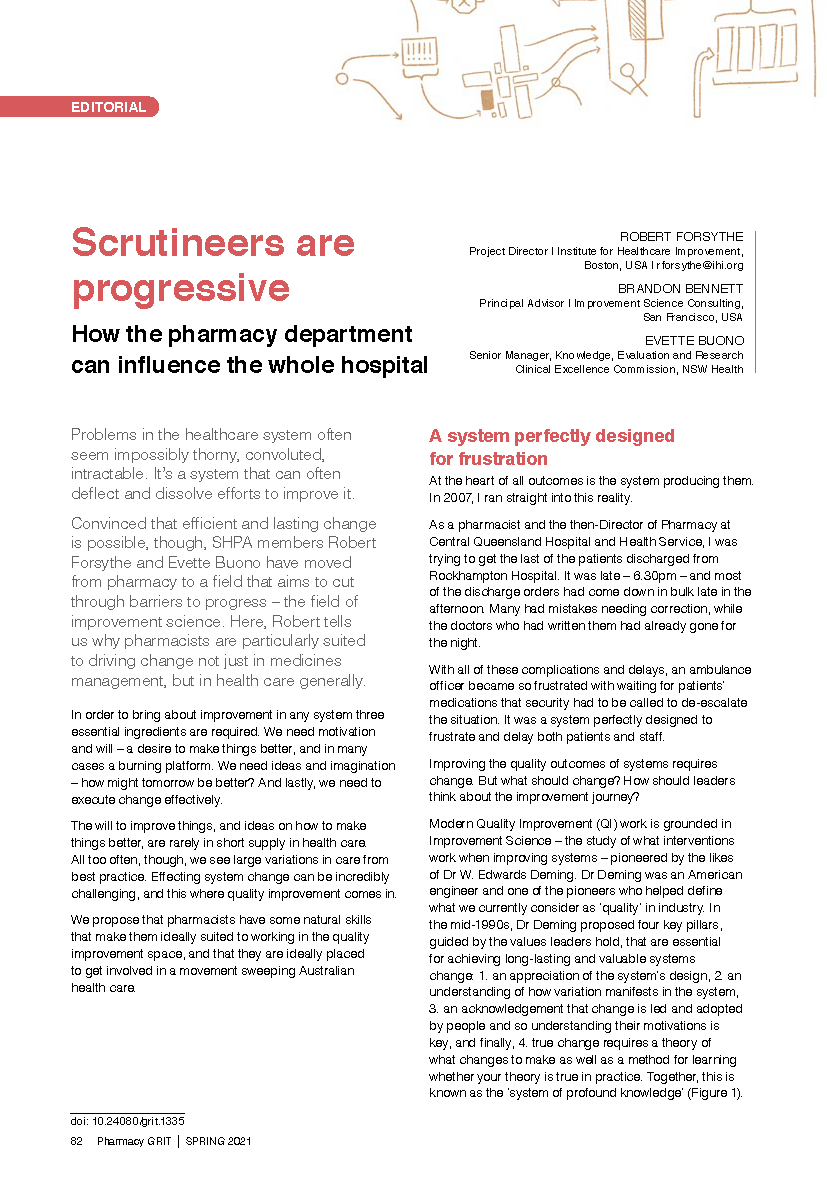
Scrutineers are progressive How the pharmacy department can influence the whole hospital
In this editorial, Robert Forsythe, Brandon Bennett, and Evette Buono argue that pharmacists are well placed to lead improvement work, bringing systems thinking, measurement, and practical change leadership to the challenges of healthcare delivery.
-
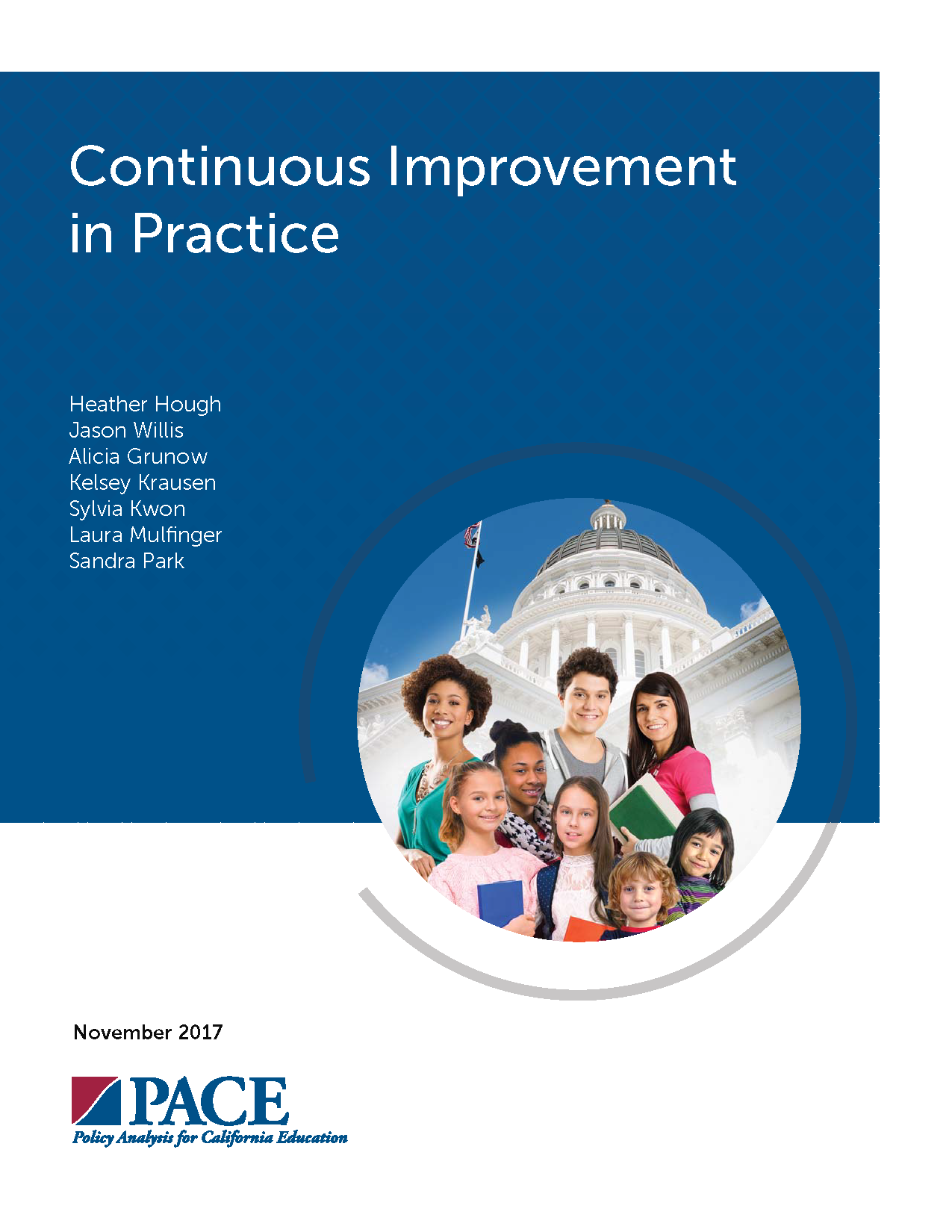
Continuous Improvement in Practice
Heather Hough, Jason Willis, Alicia Grunow, Kelsey Krausen, Sylvia Kwon, Laura Mulfinger, and Sandra Park outline how continuous improvement is understood and enacted in California’s education system, highlighting both promising practices and barriers to implementation.
-

Improved management of acute kidney injury in primary care using e-alerts and an educational outreach programme
In this planned experiment, James Tollitt, Emma Flanagan, Sheila McCorkindale, Sam Glynn-Atkins, Lauren Emmett, Denise Darby, James Ritchie, Brandon Bennett, Smeeta Sinha, and Dimitrios Poulikakos show how combining AKI e-alerts with educational outreach improved response times for acute kidney injury in primary care.
-

Implementation and effects of Enhanced Recovery After Surgery for hip and knee replacements and fractured neck of femur in New Zealand orthopaedic services
Suzanne Proudfoot, Brandon Bennett, Simon Duff, and Julie Palmer show how collaborative improvement methods helped orthopaedic teams in New Zealand adopt Enhanced Recovery After Surgery pathways and improve outcomes for elective hip and knee patients.
-

Primary Care Collaboration to Improve Diagnosis and Screening for Colorectal Cancer
DescriptioGordon D. Schiff, Trudy Bearden, Lindsay Swain Hunt, Jennifer Azzara, Jay Larmon, Russell S. Phillips, Sara Singer, Brandon Bennett, Jonathan R. Sugarman, Asaf Bitton, and Andrew Ellner show how a primary care collaborative applied improvement science to strengthen colorectal cancer screening and follow-up through shared learning, practical tools, and disciplined testing.n goes here
-
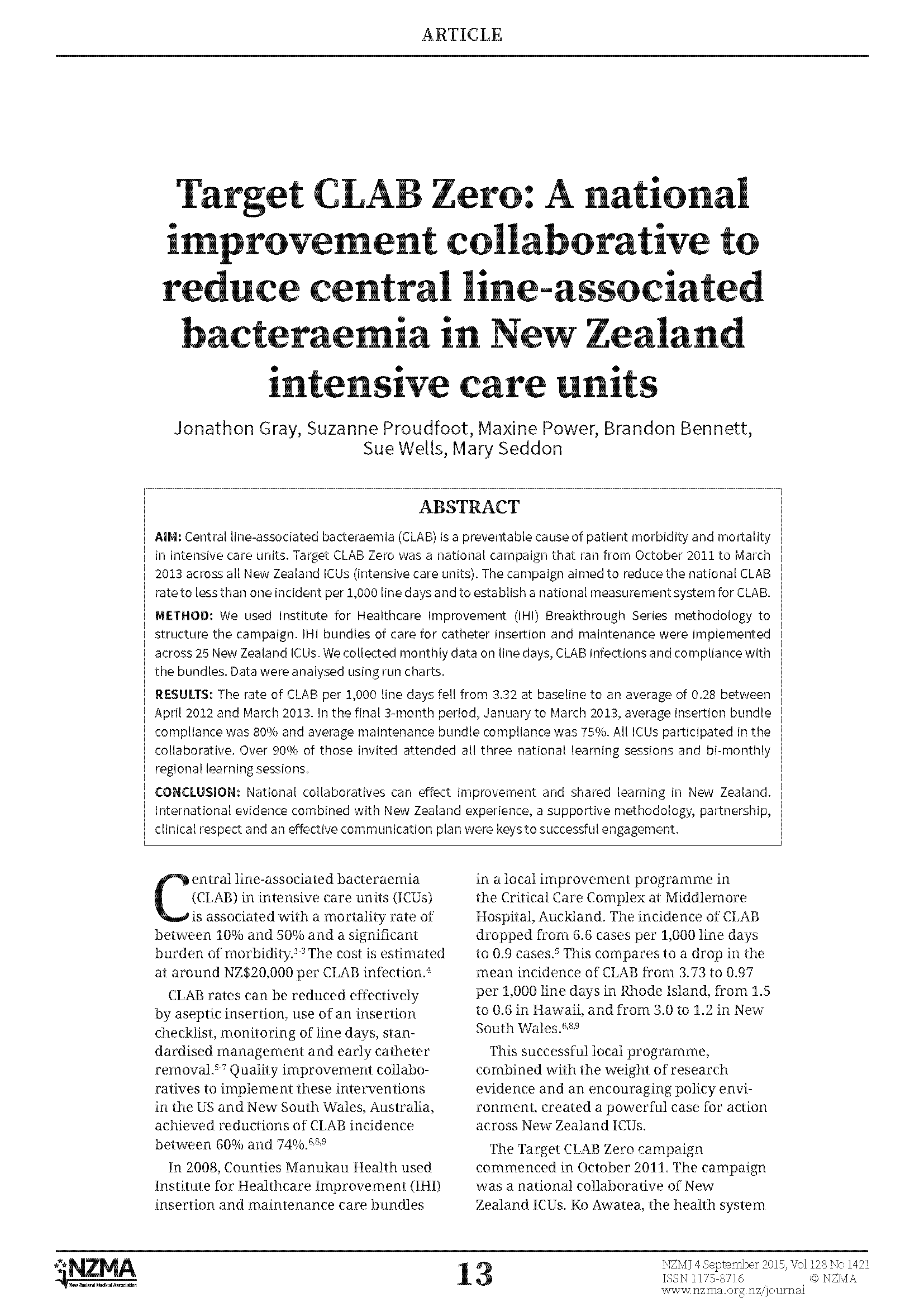
Target CLAB Zero: A national improvement collaborative to reduce central line-associated bacteraemia in New Zealand intensive care units
Jonathon Gray, Suzanne Proudfoot, Maxine Power, Brandon Bennett, Sue Wells, and Mary Seddon show how a nationwide improvement effort helped New Zealand intensive care units reduce preventable bloodstream infections and establish a common system for measuring progress.
-
Getting Ideas into Action: Building Networked Improvement Communities in Education
Anthony S. Bryk, Louis M. Gomez, and Alicia Grunow make the case for networked improvement communities in education, grounded in improvement science, showing how shared goals, common methods, and learning across contexts can accelerate improvement at scale.
-

Improving public health information: a data quality intervention in KwaZulu-Natal, South Africa
Wendy Mphatswe, Keith S. Mate, Brandon Bennett, Jay N. Reddy, Patricia M. Barker, and Neil Rollins show how applying improvement methods to data quality helped teams strengthen the completeness, accuracy, and usefulness of public health information in KwaZulu-Natal, South Africa.
-
Challenges for Routine Health System Data Management in a Large Public Programme to Prevent Mother-to-Child HIV Transmission in South Africa
Kedar S. Mate, Brandon Bennett, Wendy Mphatswe, Pierre Barker, and Nigel Rollins show how weak routine data systems can limit improvement efforts in PMTCT care, and why better data quality is critical for managing and improving performance.
-

Strategies for the Scale-Up of Antiretroviral Therapy in South Africa through Health System Optimization
Pierre M. Barker, C. Joseph McCannon, Nupur Mehta, Cathryn Green, Michele S. Youngleson, Justin Yarrow, Brandon Bennett, and Donald M. Berwick show how health system optimization and collaborative improvement methods can expand access to antiretroviral therapy in resource-constrained settings.